The Founding Years
In the first half of the 19th century the British Isles were in the grip of the first Industrial Revolution. The city of Manchester, in the English midlands, experienced phenomenal growth which transformed it into Britain’s second largest city. The cotton industry was the main driver of this expansion, and provided work for many in its cotton mills. However, employment for the factory mill workers was long and could be dangerous, whilst living conditions for many of them was often difficult, even appalling.
In 1844 a German visitor, Friedrich Engels wrote in The Condition of the Working Class in England that Manchester was “a place of dirt, squalid overcrowding, and exploitation,” and its historic centre a place of “filth, ruin and quite simply, “Hell on Earth”.
Archibald Prentice wrote in 1851 in Historical Sketches and Personal Recollections of Manchester : “The volumes of smoke which, in spite of legislation to the contrary, continually issue from factory chimneys and form a complete cloud over Manchester, certainly make it less desirable as a place of residence than it is as a place of business; and the enjoyment of the inhabitants would be greatly increased, could they breathe a purer atmosphere, and have a brighter and more frequent sight of the sun”.
So for many people, by the mid 19th century Manchester was not a pleasant place
to live, or raise a family.
Late in 1851 the news of the discovery of gold in the fledgling colonies of eastern Australia reached England. By the middle of 1852 interest in England of these gold finds had reached fever pitch, and thousands of people courageously decided to leave their homeland and head for a vastly unknown destination on the other side of the world, in the hope of finding a fortune.
One such couple was RICHARD HENRY SUTTON and MARY JOHNSON. Both were Manchester born : Richard’s father was a builder, and Mary’s father a brewer. The couple had married on Christmas Day 1852, when Richard was 22 and Mary 16. Their first child, ELIZABETH SUTTON, was born in September 1853, and on 6th June 1854 the small Sutton family boarded the famous American clipper ship Invincible in Liverpool and sailed for Australia. They arrived in Melbourne, Victoria 76 days later, on 26 August 1854.
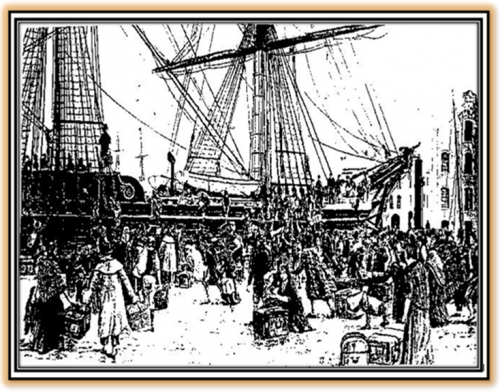
The Suttons had arrived in the depths of a Melbourne winter; they soon learned that horrendous cold, rain and mud and other supply problems made travelling overland anywhere at that time of year very difficult, so they elected to wait in Melbourne until the weather improved. Richard had learned to play the piano in his younger days back home, and he found temporary employment in an orchestra in Melbourne. By November 1854 the Suttons could wait no longer and they set off for the Ballarat goldfields, 117 km (73 miles) away to the NW of Melbourne. After an agonisingly slow journey on a bullock dray, they finally arrived in Ballarat on 21 November 1854.
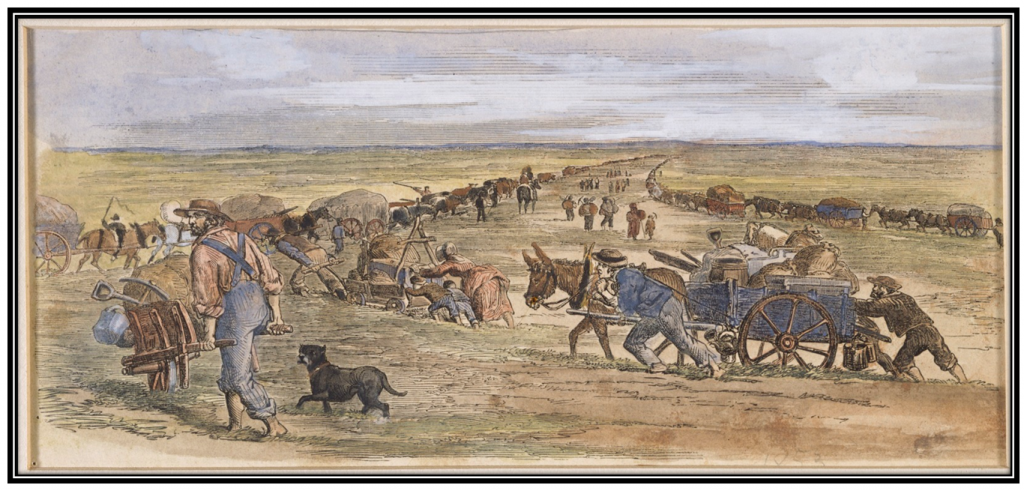
On their arrival in Ballarat they pitched their tent on Bakery Hill, and no doubt Richard tried his hand at gold-digging. The Suttons first night on the goldfields was not a happy one – a great storm swept the district and blew their tent away and left the family exposed to the elements. A few days later, the historic Eureka Stockade battle between disgruntled miners and government soldiers was fought just a short distance away from where the Suttons were camping.
Richard constructed a concertina to entertain his little family in the evenings, and the sound of it’s music drew many entertainment-hungry miners to their tent. The Suttons quickly saw the possibilities of this situation, and decided to send to Melbourne for more supplies of this instrument. In a short time Richard’s concertinas became well-known on the Ballarat district, and a small wooden display case was erected in the front of their tent, whilst their living quarters were in the back.
Thus, late in 1854, the first Sutton music store was born.

In September 1855 Mary gave birth to their second child, son HENRY SUTTON, whilst the family was still living in their tent.
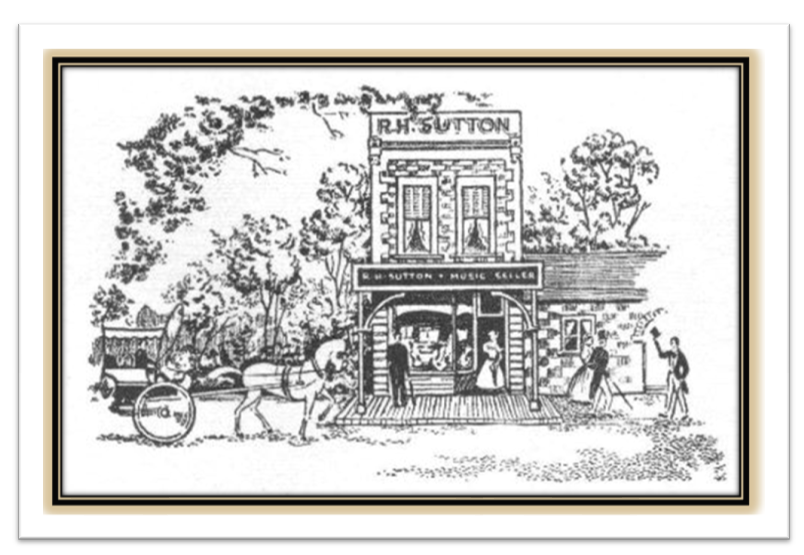
The area of Bakery Hill was, during the 1850s, the hub of the Ballarat goldfields – all the unmade tracks leading to the goldfields met nearby in a narrow gully which was also the site of a rich gold lead. The multitudinous diggings in the area were plagued by major flooding, dust, frequent fires, noise, a proliferation of mine shafts, debris, noxious fumes, polluted water and general environmental degradation associated with goldmining. Despite all this, Ballarat entrepeneurs started erecting small timber premises to catch the passing trade and Richard Sutton wanted to be one of them. He moved his family and his trade goods to a small building on what was then called “Plank Road” – due to the wooden planks put down to facilitate traffic – and on 26 January 1856 he opened a store under the name
R.H.SUTTON MUSICAL REPOSITORY
By 1857 it had been renamed
RICHARD SUTTON, MUSIC SELLER
Another son, ALFRED SUTTON was born in 1857.
In 1858 the Victorian government decided to put up for sale some parts of “non-auriferous” Ballarat land. Richard Sutton was able to purchase for £40 the block of land on the route by then called “Main Road” on which his current store stood.
Then in 1859 another son, WALTER SUTTON was added to the Sutton family.