Another Depression and A Long Fight for Survival
On 24th July 1930, not long after his 73rd birthday, Alfred Sutton died.
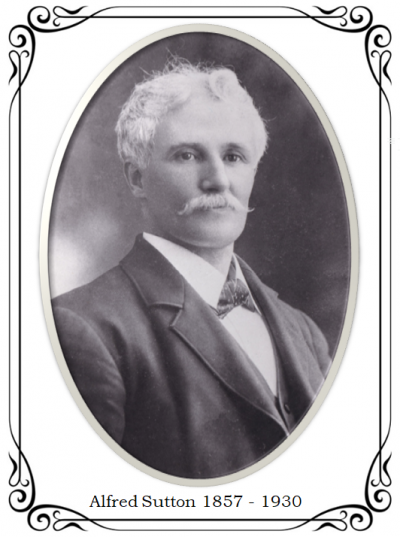
Alfred’s health had been failing for a couple of years before his death. His wife died 3 months later; she was too ill to attend her husband’s funeral so a private service was held. Alfred Sutton must have seen the financial difficulties that the company was experiencing in that time of economic depression; hopefully this knowledge did not accelerate his demise.
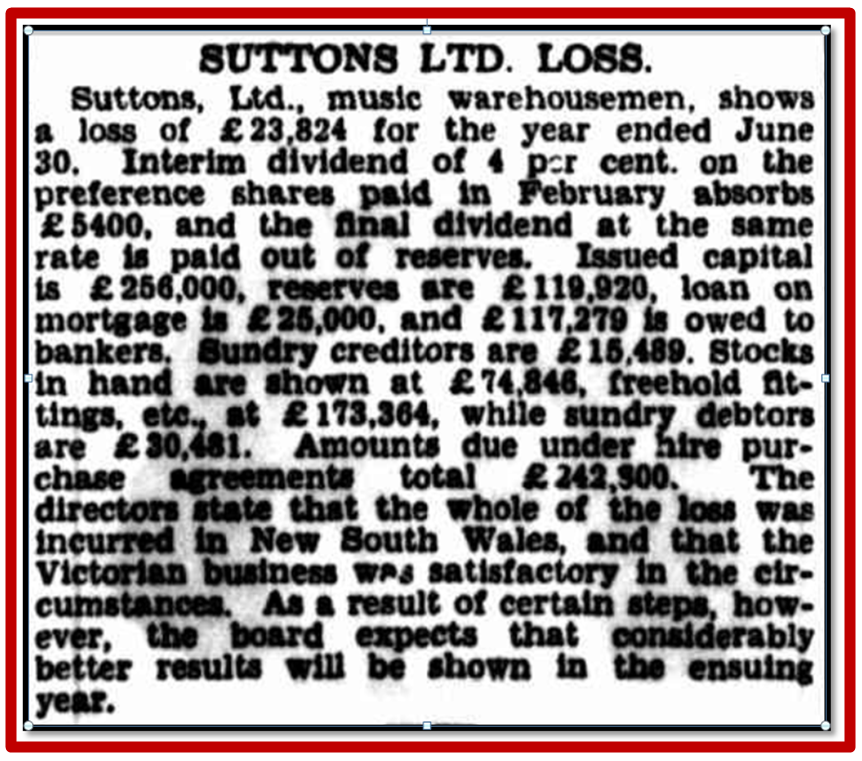
Alfred’s elder son, Alfred Leslie (Les) Sutton was elected as Chairman of Suttons Board of Directors, and it was up to him to deliver the sobering news of the company’s financial situation to its shareholders in September 1930. Les reported that the whole of the losses sustained by the company during 1929/1930 were incurred in Sydney. The depression had affected trading, but general establishment expenses for the Sydney store had been excessive, the branch had been overstocked, and it had been necessary to advertise very extensively to obtain business. About 30 – 40 employees at the Sydney store were dismissed.
However, the trusted Sutton employee sent to wind up the Sydney branch, Stan Stubley, had managed to make an improvement in its trading situation, so the liquidation was put on hold and the store given another chance to continue.
Below : Part of the Financial Report delivered by Les Sutton
TROVE : Sydney Morning Herald 30 September 1930
Radio was the new “in-thing” in home entertainment. In general, the public now preferred to enjoy music “ready-made” rather than be sourced from themselves by playing an instrument. During the long 1930s Depression era, Suttons, like all other musical instrument retailers at that time, were advertising “slightly used” pianos for sale at reduced prices, as radio technology became more popular.
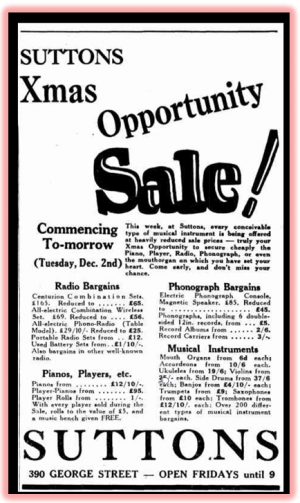
Above : TROVE The Sun 1 December 1930
In January 1931 the Suttons’ Bendigo store was moved from Pall Mall to the corner of Mitchell & Queen Streets, after a protracted effort to find a buyer for their Bendigo premises.
Despite all the changes Suttons had made, their “bottom line” at the end of the 1930/1931 financial year was still unfavourable. Again it was the Sydney branch which was seen as responsible, so once again, the decision to close the NSW store was taken.
In his report to shareholders in 1931, Les Sutton stated that it was the political & financial conditions in NSW [aka “Langism”] which was to blame for the company’s losses in that state, whereas “the Victorian businesses had never shown a loss since inception”.
Again Suttons drew on it’s dwindling financial reserves to pay dividends to its concerned shareholders.
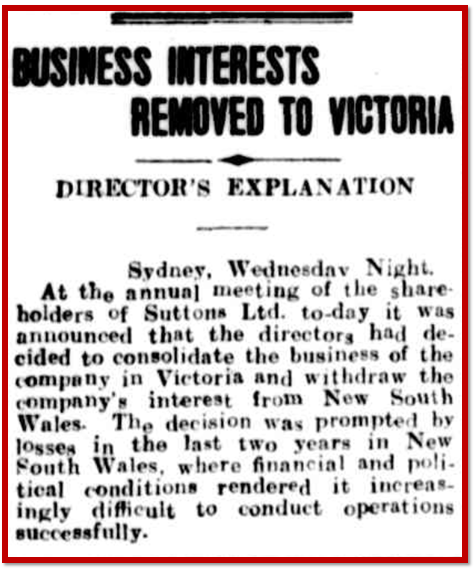
Above : TROVE Barrier Miner 1 October 1931
In October 1931 the failing Sydney store was advertised for “Lease, with option of purchase”. Suttons continued trading from there, but there were no takers for either purchase or lease of the premises in such a high-profile city location in the midst of the Depression.
Meanwhile, the salaries of staff & directors were again reduced to help keep the company viable.
In February 1932 payment of the dividend due on preference shares was deferred.
By mid-year there had been several mentions in newspapers of Suttons seeking permission in the courts to go after defaulting hire-purchasers, yet they were still offering HP as an option for new purchases.
In May 1932 in an article in a Sydney newspaper, Suttons was named as one of those businesses intending to leave, or avoiding operating, in the state of NSW due to Premier Lang’s political environment.
Les Sutton continued his battle to save the family music business…
In mid 1932 the landmark Suttons premises in Sturt Street Ballarat was finally sold, the announced intention being that “the Sutton music business in Ballarat was to cease altogether”. However, this is not what transpired… new premises were taken at the corner of Sturt & Dawson Streets in Ballarat.
In September 1932 the Suttons AGM was held in Melbourne, and Chairman Les Sutton again delivered a sobering report to the shareholders.
“A loss of £42,634 on the year’s operations was reported at the annual meeting of shareholders of Suttons Limited at the office of the company, 290 Bourke street, yesterday. The chairman of directors (Mr. A. L. Sutton) attributed this loss to the difficulties of the hire-purchase accounts, including the creation of reserves to cover uncompleted and cancelled sales, which amounted to £17,719. Losses were also sustained through the depreciation of Australian money overseas, and £5,950 was written off shares in other companies. He reported that competition in radio goods had been very keen, and that changing models and new inventions had made the trade difficult. Stocks had been reduced by £18,065 and debtors by £9,526, while liabilities were lower by £5,394 in the year. Mr. Sutton said that included in the economies which were carried out was a general reduction in the wages of staff and directors. The business at Ballarat had been moved to new premises, with the benefit of a reduction in rent and staff, but the property in George street, Sydney, had not yet been sold. Mr. Sutton said that there were hopeful signs of an improvement in business. The reserve fund was £58,093, and the policy of the directors was to reduce expenditure and all liabilities. Replying to a request from a shareholder for a reduction of the company’s capital and of the interest payments, Mr. Sutton pointed out that the company was paying no interest at the present time, and that the directors would consider a reduction of capital later. The annual report disclosed that during the year … no dividends on preference shares had been paid. The report and balance-sheet were adopted. Mr. F. H. Sutton was re-elected to the board of directors, and the auditors, Messrs. William Buck and Son, were also re-elected.”
Meanwhile, the effects of the Depression dragged on…
In Melbourne, the flagship Bourke Street store underwent renovations, largely to cater for the new ranges of stock being offered in radios.
In Sydney, in early November 1932 the Suttons premises at 390 George Street was finally sold for £40,000 – a devastating loss to the company of £20,000 in just 2 years.
Les Sutton dispatched his brother Stanley to Sydney to assist in the winding up of their NSW branch. However, with much determination and innovative advertising, by the end of the same month Stanley Sutton had managed to improve the company’s NSW trading situation enough to organise the opening of a new NSW city store at 38 York Street Sydney.
In February 1933 the Directors of Suttons were :
Alfred Leslie Sutton (Chairman)
Stanley Sutton
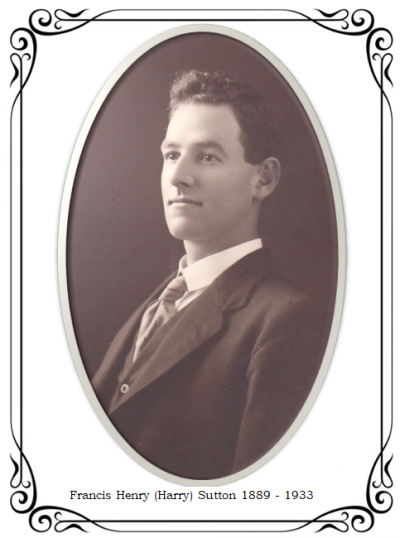
Francis (Harry) Sutton
Alexander Law, and
Ray Nason (an accountant & shareholder representative)
The Company Secretary was James Marshall Sayer (brother-in-law of Les & Stan Sutton).
In April 1933, despite the renovations a few months earlier, the Suttons Melbourne premises @290 Bourke Street was put up for sale, to be auctioned a month later, and the company began advertising a “Removal Sale”. But the building did not sell at auction; it was passed in at £100,000, the reserve was set at £125,000 but later reduced to £115,000.
Below : TROVE The Argus 22 April 1933

Two months later a fire broke out on the upper floors of the Bourke Street store in Melbourne; damage was largely due to water from the sprinkler system. Later that month, Suttons announced they had leased out part of their building, which the directors hoped would reduce overhead expenses.
By the end of the 1932/1933 financial year, despite all these drastic actions taken by Suttons’ management, in September the 1932/1933 annual report again made bleak reading. Once again a “large loss” was incurred, and it was hoped that “some scheme of reconstruction of the company‘s affairs would be satisfactory to shareholders.”
Below : On November 30 1933 Suttons director, Francis Henry (Harry) Sutton died.
Also in 1933, two of the teen-aged grandsons of Alfred Sutton, Douglas M. JONES and Jeffrey A. SUTTON began working in the family music business : Douglas in Melbourne and Jeffrey in Sydney.
Below : TROVE The Herald 26 January 1932
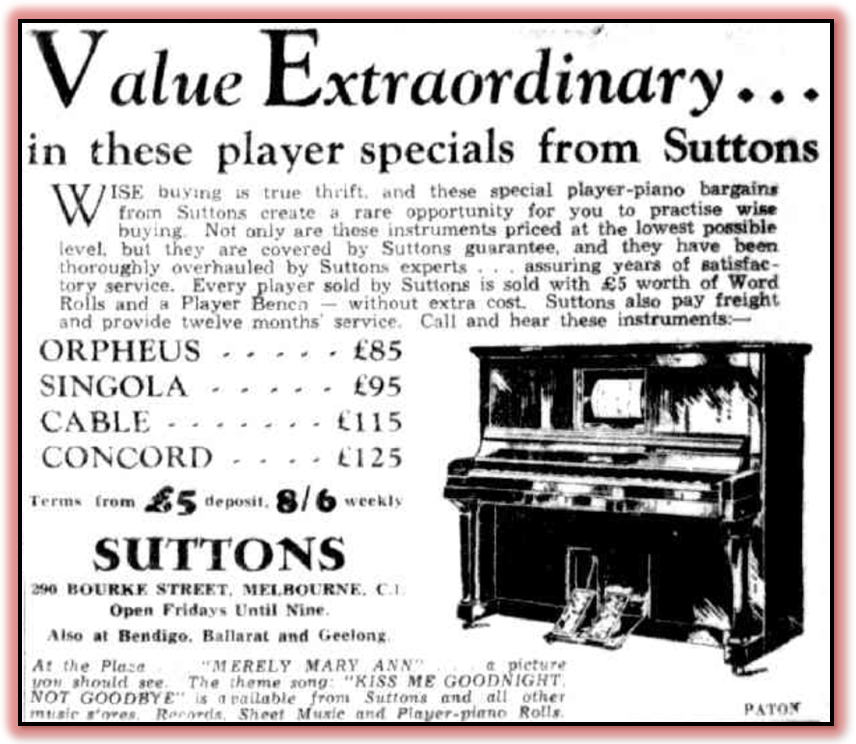
In December 1933 the decision was taken to wind up the Concord Piano & Player Co. Pty Ltd. and it was put into liquidation, under the supervision of Suttons Board member, Mr Ray Nason. A successful 3-day auction sale was held in Melbourne of its woodworking machinery, plant & stock of veneers and parts, and also 12 new player-pianos & pianos, with buyers attending from all parts of Victoria and NSW.
In April 1934 a buyer was finally found for the Bourke Street store, with whom Suttons negotiated a “long lease” to remain trading in the location until a mutually convenient time in the future, which transpired to be in 1938.
Most of Australia’s government and commercial broadcast radio stations were formed by 1934. Program content usually consisted of the station announcer or presenter armed with a library of household gramophone records. The bigger stations began providing dramas and musicals produced in their own studios and aired direct to their listeners.
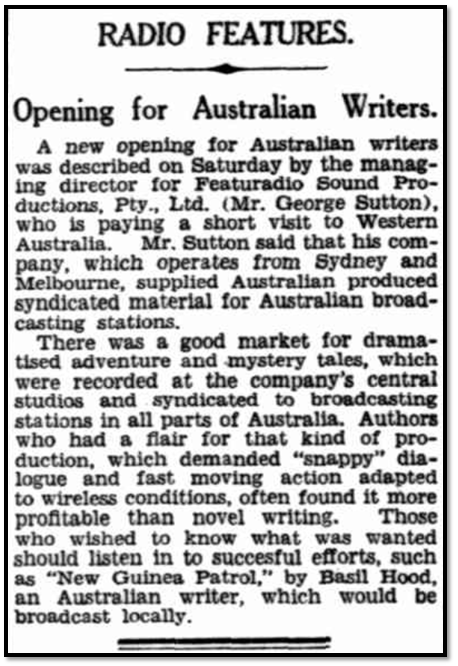
In June 1933 F.George Sutton & his brother-in-law, the Suttons’ Company Secretary, James M. Sayer, formed the School of Broadcasting Pty Ltd, trading under the name Featuradio. The original aim was to supply commercial continuities, scripts and live talent for studio presentations by stations lacking facilities for any or all of those things. It soon began training copywriters and announcers, even supplying two to the national stations. Featuradio was also instrumental in developing the recorded commercial into a work of dramatic artistry. By 1935 George Sutton was importing more up-to-date equipment, and experimenting in recording technology. From its inception it played a significant role in many aspects of the local radio industry, as a recorder of local artists and a major distributor of local and international recordings. Suttons Ltd. involvement with Featuradio ceased when the business was sold in 1936. George Sutton continued to be its managing director until it became the Australian Record Company in 1938.
Below : TROVE West Australian 20 April 1937
With the effects of the world depression still significantly affecting demand for pianos and musical instruments, mainly due to the advent of the radio/wireless, the directors of Suttons Limited again acted…
In May 1934 the company held an extraordinary general meeting of its shareholders at which a previous resolution for repayment of preference capital was unanimously passed : the company was to repay the amount paid up on 135,000 preference shares, and the shareholders waived their right to accrued and accruing dividends at the rate of 8% per annum from June 1931 to the date of repayment, and the acceptance of £ 1 per share. [Preference dividends at December 31st 1933 were by then 2 1/2 years in arrears.] This reduced the company’s capital from £500,000 to £300,000 ordinary shares of £1 each and cancelled the whole of the 200,000 preference shares in the capital of the company.
In November 1934 Suttons Limited again changed its name to
SUTTONS PROPRIETRY LIMITED.
By April 1935 the number of Suttons directors stood at 4, after the death of Harry Sutton and the resignation of 2 other directors. This left 3 members of the Sutton family as Directors : Les Sutton, Stanley Sutton and James Sayer.
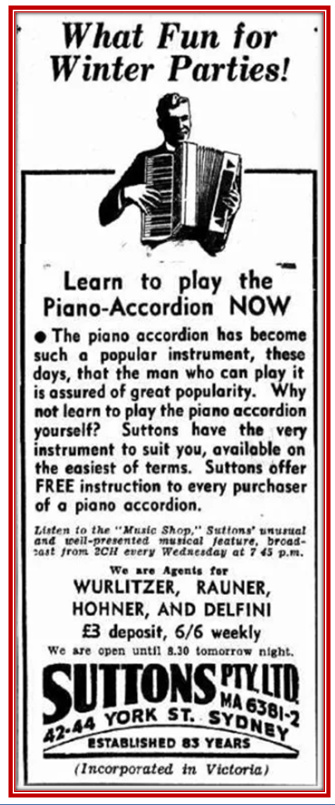
By late 1936, a significant part of the stock carried by Suttons was in radio receivers, although there were still pianos & pianolas which were by then almost within the same price range. Piano accordions were popular, largely due to the influx of European migrants to Australia. Suttons advertisements for these instruments were often seen in Italian newspapers, whilst sheet music, gramophone records, player rolls and mouth organs, along with the traditional orchestral instruments were also stocked.
Below : TROVE The Daily Telegraph 7 April 1938
In November 1936 Suttons and nine other large businesses were sued by Walt Disney for copyright infringements, for using images of Mickey Mouse on some of their goods, without permission. All the involved companies were fined £150.
Throughout these difficult economic depression years the Suttons chairman, Les Sutton, a talented watercolour & oils artist in his spare time, sought distraction from the stresses of keeping the family music business afloat by indulging in this hobby, whilst also coping with the breakdown of his marriage.
Meanwhile in Sydney, his younger brother Stanley Sutton was also feeling the stress of his business responsibilities… the strain of the effort Stan had put into rescuing the NSW branch had taken its toll, and he was forced to retire from an active role in Suttons management in 1937.
In April 1938 the Suttons Pty Ltd store in the Victorian capital moved to new premises at 105 Elizabeth Street, Melbourne.
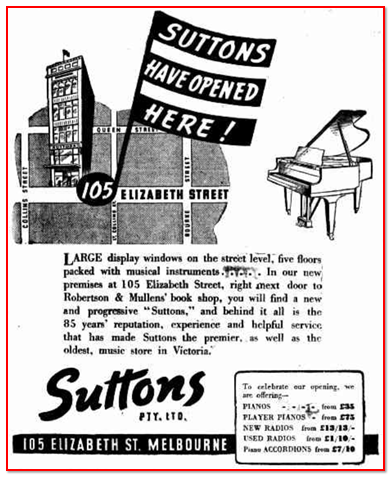
Above: TROVE The Herald 5 April 1938
With Stan Sutton no longer available, James M.Sayer was appointed a director on the Suttons board.
The following year of 1939, World War II began and Australia was again at war.