Time of War & Changes
Alfred Sutton’s grandsons, Douglas M. Jones, and Jeffrey A. Sutton both enlisted for war service; each was destined to play significant roles in their Sutton family music business when they returned to civilian life.
With Australia again at war, music at home – often military band-style – was generally listened to on the radio, although the phonograph was becoming affordable for households. Music of the 1940’s was also the decade of the crooner, whilst in the jazz scene, swing was popular. The supply of new musical instruments for Suttons to sell was severely limited during the war years.
In 1939 Stanley Sutton formally resigned from the Suttons directorate due to his continuing ill health.
During the war years, in newspaper advertisements, Suttons was offering to pay cash for players, pianos and other instruments, and would “take delivery at the home”. They were also seeking piano player actions, even from out-of-order instruments. New European stock was almost impossible to obtain.
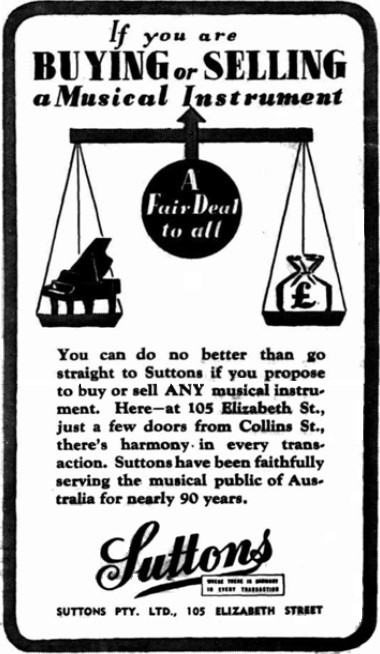
Above : TROVE Advocate 13 June 1945
On 22 November 1941 Les Sutton suddenly died aged just 52, leaving the position of Chairman of Suttons’ Board of Directors vacant. There remained just 2 Suttons directors : James M.Sayer, the son-in-law of Walter Sutton, and Alex Law Snr.
With the availability of any of the younger generation of Sutton members limited by their war service for an unknown period, the vacant board positions had to be filled by suitably experienced persons who were still available.
In December 1941 Stanley Stubley, manager of the Sydney branch since the resignation of Stanley Sutton, was appointed to the directorate. F.George Sutton, Walter Sutton’s son, was temporarily re-appointed for a year’s active tenure, after which he re-enlisted with the Australian Army and he took no further active role in Suttons directorate for the remainder of the war.
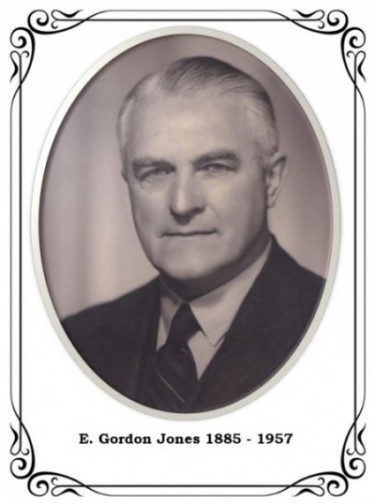
The husband of Alfred Sutton’s daughter Violet, E.Gordon Jones [below] was appointed to a position on the Suttons directorate as shareholder representative of Alfred Sutton’s descendants’ shareholdings, who at that time between them held the largest number of shares in the company.
By 1942 the Australian government was running short of money to continue building defences to protect the country from its approaching enemies. It instituted a series of “Liberty Loans” which asked the Australian people to subscribe funds to help in the defence of their homeland. Patriotically, Suttons Pty. Ltd. sponsored newspaper advertisements for these loans; in April 1943 Suttons donated £18,000, and a further £10,000 6 months later.

Below : TROVE The Herald 16 October 1943

In March 1944 George Armstrong, an accountant with Suttons’ Melbourne office, was appointed a director and Company Secretary, whilst James M.Sayer was appointed as Suttons’ General Manager.
Alex Law Sr. died in late April 1944, and E.Gordon Jones was appointed as the Chairman of Directors.
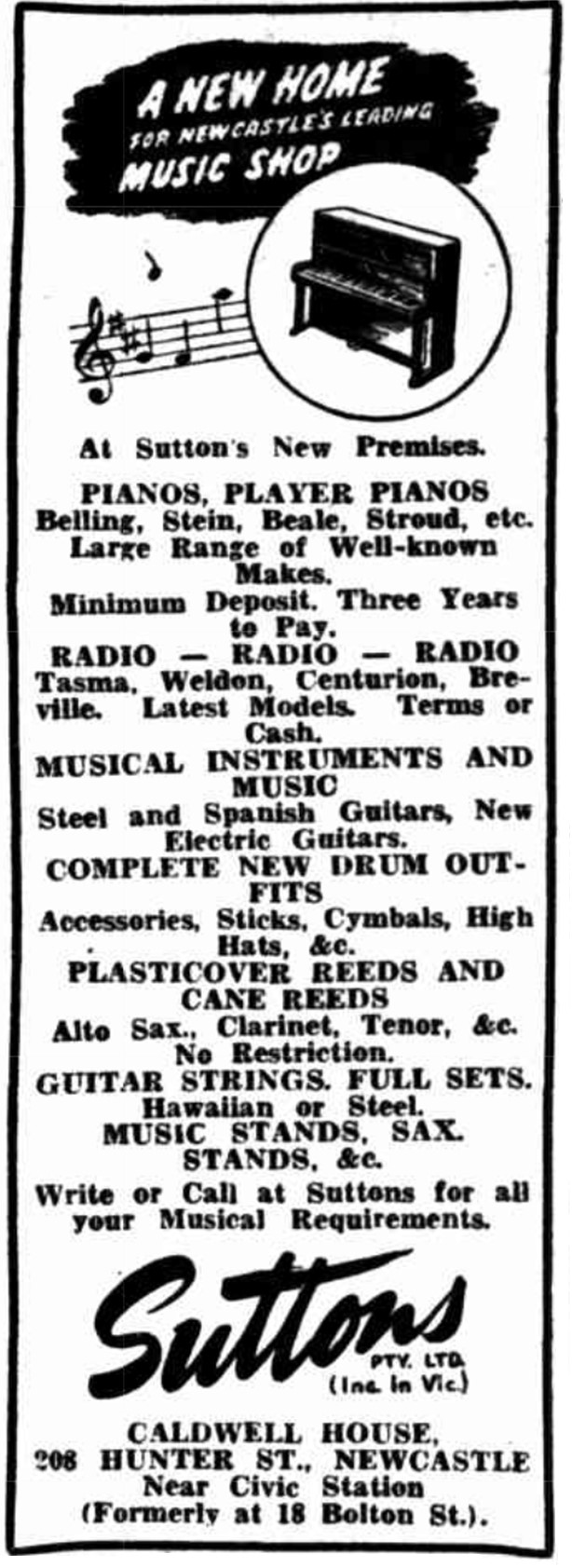
Late in 1944 both Douglas M.Jones (son of Violet Sutton & E.Gordon Jones) and Jeffrey A.Sutton (son of Stanley Sutton) were discharged from their war service and became available to take positions within Suttons’ management. Both young men were assigned roles in New South Wales : Douglas Jones was appointed as Manager/Accountant at the Sydney branch; Jeffrey Sutton to Newcastle to expand the agency which had been there since before the war. By mid August 1945 Jeffrey had opened a new retail store at 18 Bolton Street, Newcastle; early in the next year this branch had been moved to a more convenient location at Caldwell House, 208 Hunter Street, Newcastle.
Below: TROVE The Newcastle Sun 10 November 1945
 Then on 9 April 1946 James Marshall Sayer died. The employees of Suttons Pty. Ltd. wrote a heart-felt tribute to him saying : “he was an esteemed director, a true and kindly gentleman, loved by all and an inspiration to his staff”.
E.Gordon Jones was subsequently appointed as a “Working Director”.
A superannuation fund was inaugurated for Suttons employees in 1946.
Post-war in Australia there was a desire for “better, worthwhile music”; the swing music which flourished during the war waned in popularity and jazz had its limitations. Comments along the lines of “aims to encourage the finer things of the human spirit” were heard in parliament; there was talk of establishment of national theatres and state orchestras; this was indeed good news for Suttons! After World War II, the ABC established full-time professional orchestras in every capital, all run by the ABC, and thus federally supported, but also with state and municipal government support.
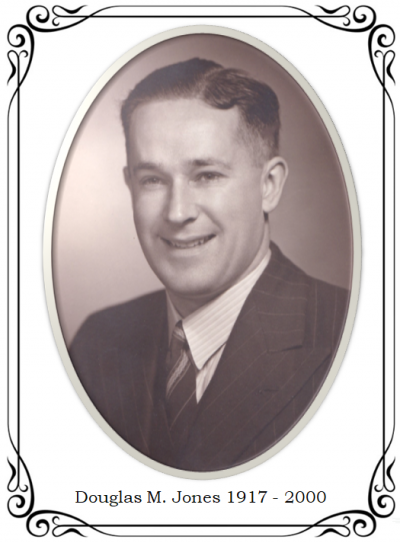
In April 1948 Douglas M. Jones, great grandson of the Suttons founder, Richard H.Sutton, and Alex Law Jr. were appointed as Suttons directors.
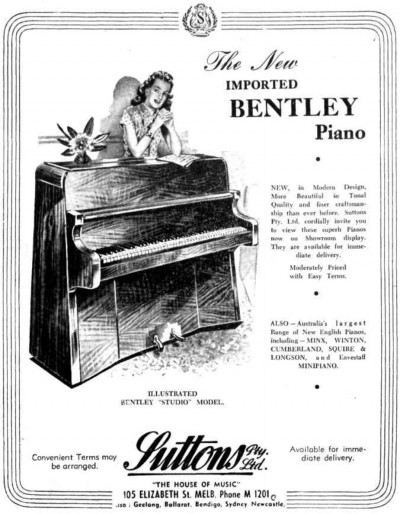
In mid 1948 supplies of modern small pianos – otherwise known as “miniature pianos” which had been made by British manufacturers – reached Suttons. These instruments were quite successful and proved to be of outstanding value, design, quality and excellent tonal quality.
A listing of Suttons shareholders dated 1949 survives, and it shows a total of 121,500 shares issued by the company. Alfred Sutton’s descendants still held the greatest proportion at 39%, Walter Sutton’s 32.6% and Frederick Sutton’s 19%. Employees and others held just over 9%. By this time, no shares were held by Henry Sutton’s descendants. That year an annual dividend of 5% was paid to the shareholders.