A New Century Brings Changes
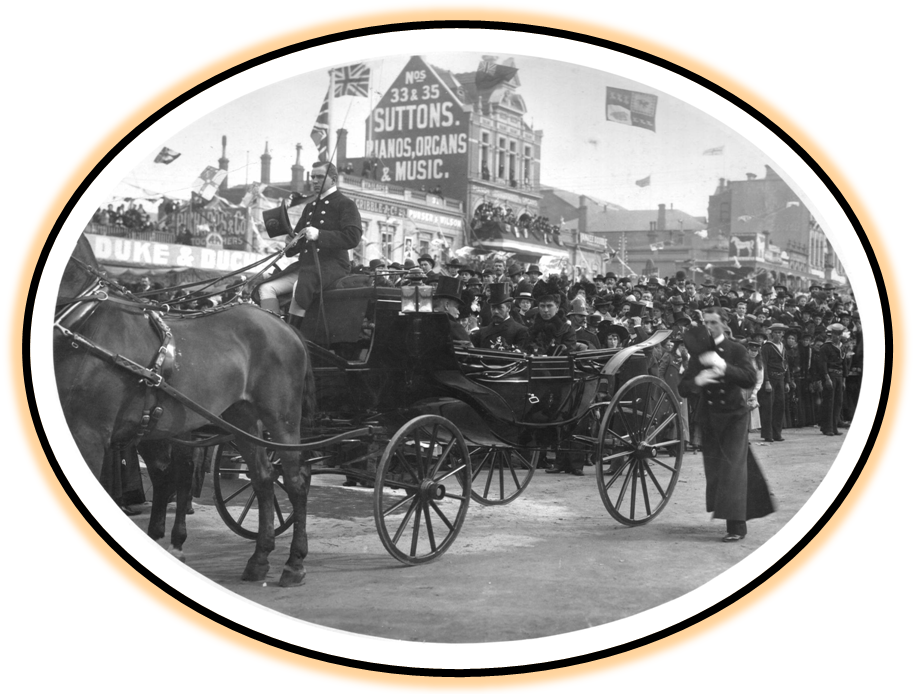
Suttons store in background [Sutton family archives]
A large proportion of the wealth of the city of Melbourne had been involved in the financial collapse of the early 1890s. In response to the events of the boom and its aftermath, the Victorian Parliament took steps towards a general reform of Company Law. In late 1900 the Sutton brothers brought their already extensive business under the 1896 Companies Act by registering with the Victorian Deputy Registrar General under the name SUTTONS LIMITED. Basically this meant the company was “incorporated and limited by shares” and a Memorandum and Articles of Association document was lodged on 6 December 1900. This trading name was only transitional, as from 1 January 1901 the company traded under the name SUTTONS PROPRIETRY LIMITED.
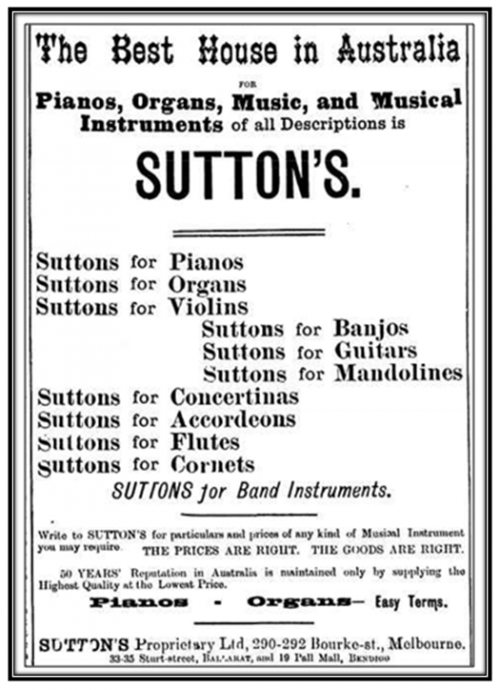
Below: TROVE Benalla Standard 15 October 1901
The re-structure meant that the existing large financial operations of the Sutton music business could be more closely controlled, and gave “increased facilities to purchasers of pianos, organs and musical goods”. Henry, Alfred, Walter, and Frederick Sutton were the sole directors of the new Company, retaining the whole of their previously held interest, so that the conduct of the large operations of Suttons was in the same hands as before.
It is probable that by this time that Suttons’ financial resources had been severely depleted during the preceding decade’s economic depression – the lavish new store in Ballarat, the refurbishment of the Melbourne store, and the new store opened in Bendigo had all occurred during the depths of the Depression period.
The 1901 company re-structure meant a new arrangement of capital and shares for Suttons : “The minimum subscription upon which the Directors may proceed to the allotment of shares shall be 8 shares fully paid up to £1 each”.
This initially allotted one share to each of the four Sutton brothers and one to each spouse. Then :
“The original capital of the Company shall be £50,000 divided into 50,000 shares of £1 each. The Directors shall at first issue an amount not exceeding £40,000 in 40,000 shares of £1 each of which 39,992 shares fully paid up to 20/- each shall be issued to Henry Sutton, Alfred Sutton, Walter Sutton and Frederick Sutton …. in equal shares…”
Thus, later in 1901 each Sutton brother had 9998 shares in Suttons Pty Ltd, worth about approximately £10,000 at that time.
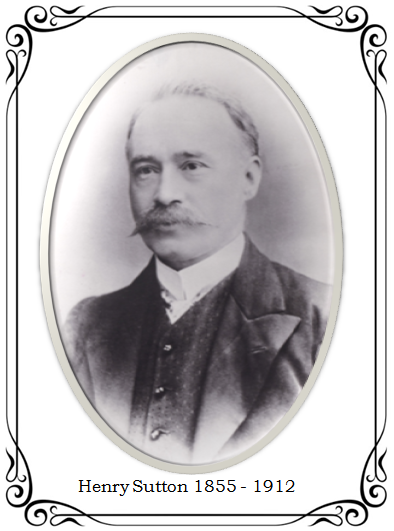
In July 1912 Henry Sutton [above] died, aged 56. After Henry’s death, his probate documents show his shareholdings in Suttons Pty Ltd had been reduced somewhat; two of his brothers had increased their holdings by a proportional amount; the other still held the same original number of shares. This implies Henry may have sold some of his Suttons shares to his brothers Alfred & Frederick sometime before his death.
In August 1903 Suttons opened their first store in Geelong, Victoria.
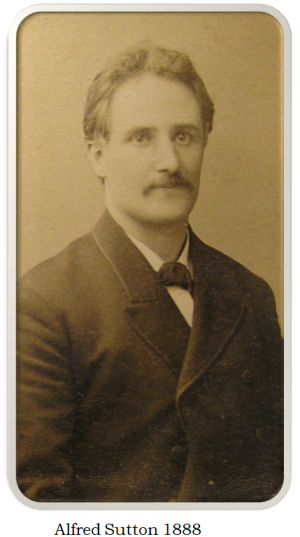
In 1904 Alfred Sutton [above] accompanied by his wife, undertook an extended overseas business trip. Before they left Sydney for America, Alfred spent some time looking at prospective locations for a store in that city, but decided the time was not right. The Suttons arrived in San Francisco on 16th May 1904, from whence they attended the St Louis Fair. They spent 9 months in the USA where Alfred successfully negotiated new stock suppliers and gained valuable agencies for various instruments. Then they continued on to England, Germany, and Italy, returning to Melbourne in December 1904. The sole agencies negotiated by Alfred on this trip proved to be great money-earners for the company for many years to come.
Trade throughout the first decade of the 20th century was generally steady and untroubled, although in 1909 a piano tuner employed by Suttons to service the rural Daylesford district was found to have embezzled the company. The charge was reduced to larceny, and he was fined.
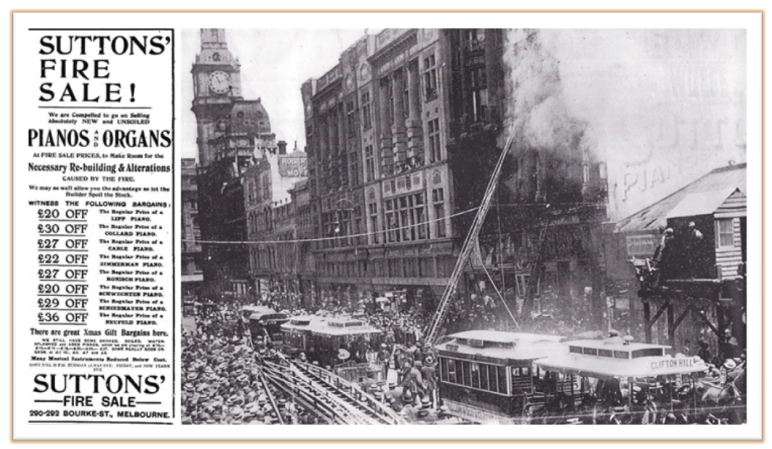
Late in November 1912 the Suttons store in Bourke Street Melbourne was affected by a fire on it’s two upper floors.
Suttons used this set-back to try and entice more customers into their store…
Below : TROVE Punch 5 December 1912
In mid 1914 the three remaining Sutton brothers became concerned that war with Europe was becoming inevitable, and as much of their stock was sourced from that area it was deemed necessary to seek out new sources of instruments to sell in their stores.

The recently-widowed Frederick Sutton was chosen to make the trip, with Walter Sutton again temporarily stepping in to Fred’s role as manager at the Ballarat store for the duration of his absence. Departing in November 1914, Fred undertook an 8 month-long overseas business trip to USA & England, where “he was engaged in transferring trade hitherto done largely with Germany to British & American firms”. Fred spent a lot of time examining the goods available in America & England and the choices he made helped the firm to manage to pull through the war period. By February 1915 Fred was in England, where he briefly met up with his sister Elizabeth and her daughter who had had to be evacuated from France when war finally broke out; he was just in time to witness his dying sister’s Will. He returned to Melbourne in July 1915.
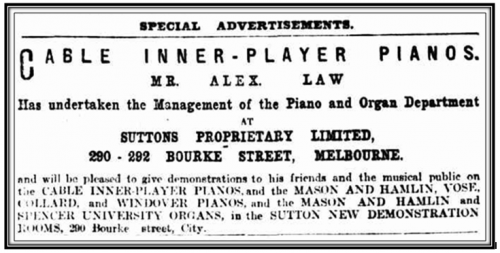
Above : TROVE The Argus 23 November 1915
Late in 1915 a previous Suttons employee, Mr Alex Law re-joined the company after a sojourn in New Zealand. Suttons was delighted to have him back in their employ, and in 1927 Alfred Sutton wrote :
“During his business connection with this house, Mr. Alexander Law has been a power of strength, and in addition to being a first class salesman and an artist from his finger tips, he possessed so many other good qualities that he was esteemed by firm and foe, and a great deal of the modern success of the company can be attributed to him”.
Alex Law’s son later went on to also hold a significant position in Suttons’ management. After Frederick Sutton’s return from overseas, it was decided to appoint Fred as Chairman of Directors of the Suttons’ board, and he took up residence in Melbourne.
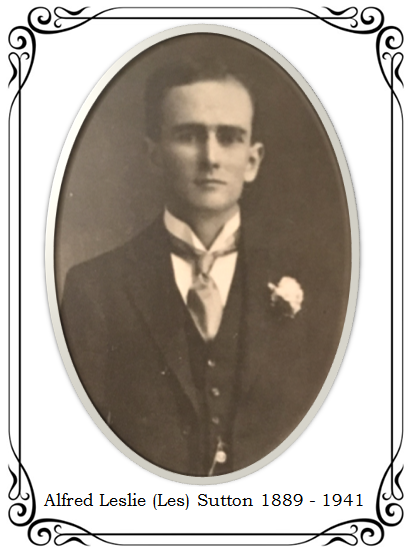
Fred’s appointment freed his brothers Alfred and Walter to concentrate on Sales and The Office respectively, and Alfred Sutton’s elder son, ALFRED LESLIE (Les) SUTTON [below] by then a qualified accountant, was chosen to replace Fred in Ballarat.
In July 1916 the manager of the Bendigo store was presented with an expensive gift by Suttons on his impending marriage; unfortunately this generosity towards him by his employers was soon abused.
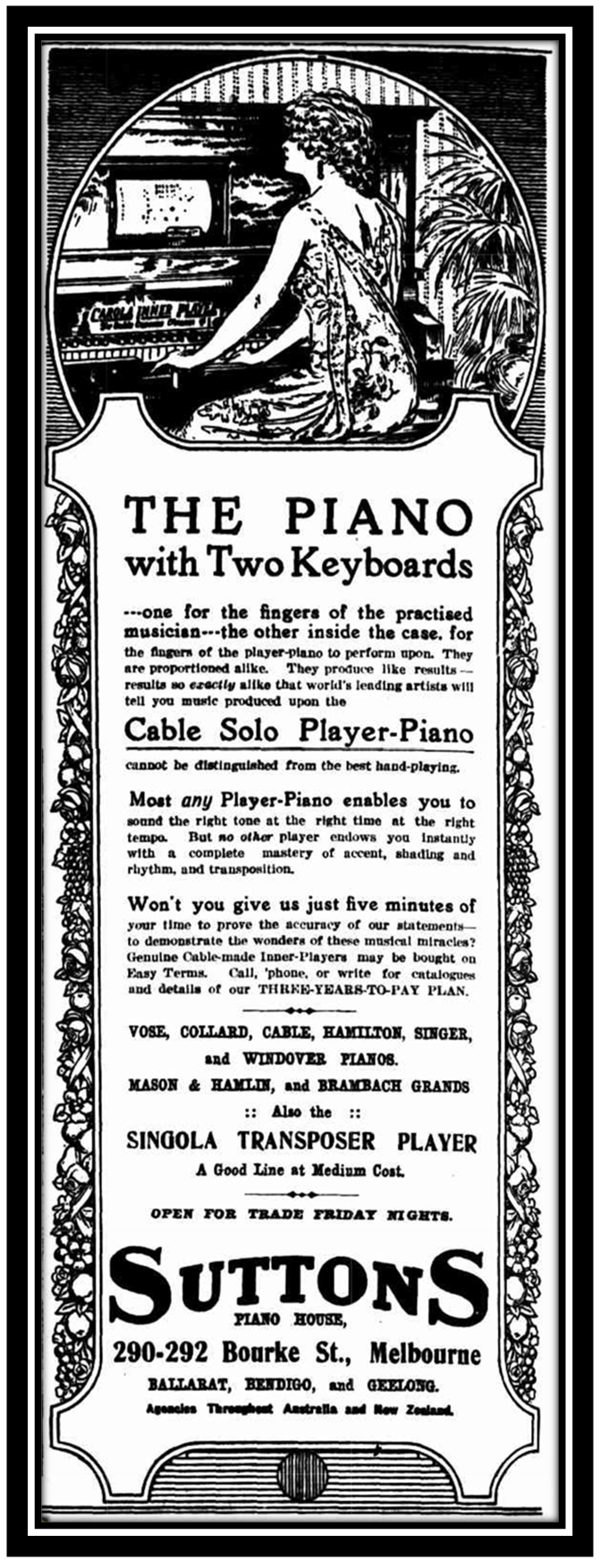
Emphasis in Suttons’ advertisements during the war period was on English-made pianos and the sale of sheet music of new patriotic songs. German-made pianos were being traded in, presumably because it was seen as unpatriotic to own one during wartime.
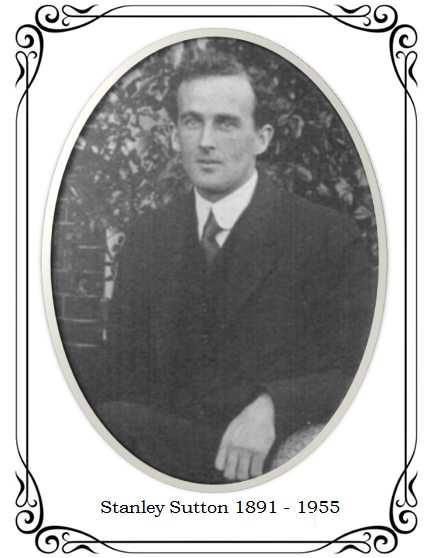
In January 1918 Suttons was in court over a customer using a false cheque to obtain money from them. In November that year another court case regarding the sale of a Suttons piano player and a Suttons “traveller salesman” began, but more serious matters developed the next year of 1919 when the the manager of the Suttons Bendigo store was found to be embezzling the company, along with this same travelling salesman. The trial of these employees lasted from August to December 1919; both were found guilty of embezzlement to the amount of £3100 and both were jailed. As a result of this unfortunate incident, in 1919 Alfred Sutton’s younger son, STANLEY SUTTON [below] was despatched to Bendigo to take over the store management there.
Below : TROVE The Argus 26 October 1918