Post War Boom then Difficulties
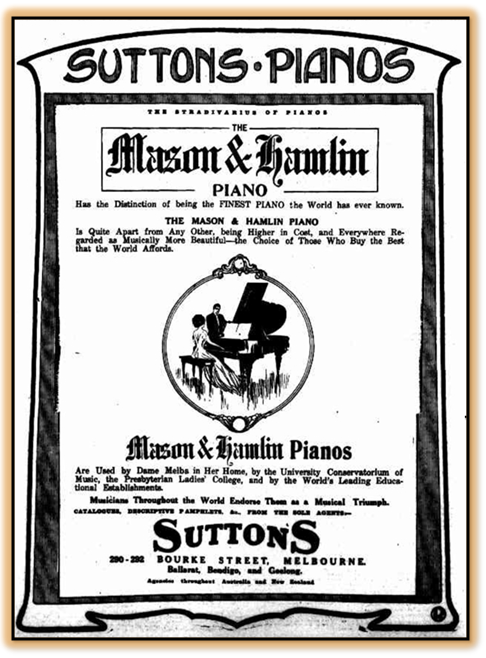
Above : TROVE The Argus 12 April 1919
On the Australian homefront during the First World War, “popular” music had flourished. It was produced quickly, performed in music halls around the country and then made its way into homes via relatively cheap sheet music, where it was sung by family and friends around the piano. After the war period, at Suttons the choice of piano manufacturers was limited, partly due to an embargo on the importation of German pianos which was not lifted until 1922.
Post WW1, the Player Piano came in with a great rush on the Australian music scene. Suttons saw the tremendous popularity its arrival generated, and decided to form it’s own Piano and Player manufacturing concern.
Below : 1925 advert which mentions the Sydney store, then just a Decca agency
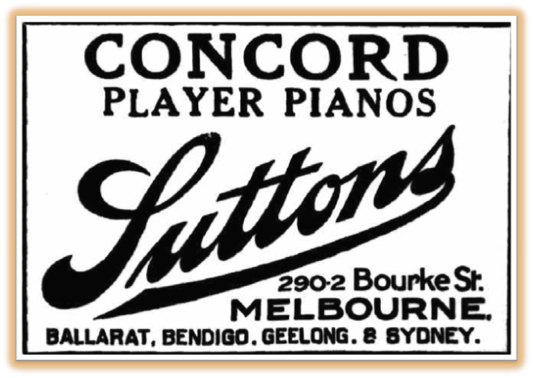
Suttons made offers to interested parties interstate to join their venture; one of these was Nicholson & Co., music warehousemen in Sydney, located at 390 George Street. [These premises were later purchased by Suttons in 1928 for their own use.]
Thus began the Concord Piano & Player Piano Company.
Registered 29 September 1920, the Concord company’s capital was £100,000 in £1 shares and the registered address was Suttons at 290 Bourke Street, Melbourne. The Concord company’s output became the chief item of Suttons’ trade for the next decade. Over that time there was a falling demand for pianos at Suttons. Initially sales of 1 player to 100 pianos were seen, then as the player gained even more popularity, by the mid 1920’s there was as many players sold as pianos. By 1927, Suttons sold 6 players to 1 new piano. Their stock of pianos was then generally obtained from second hand instruments taken in exchange for players, which shows the extent of the player’s popularity by then. Overall, the products of the Concord company were a great success as they were fine instruments in every way; this was much appreciated by the Suttons shareholders. By 1927 the factory had increased its production from one instrument per week to about sixteen.
In 1921, after considerable temporary alterations to the premises to suit the business, Suttons relocated their Geelong store from 142 Moorabool Street to the junction of Moorabool & Malop Streets, prior to a major remodelling planned for the future.
Late in 1922 the three Sutton brothers established an Australian subsiduary office of the Sam Fox Publishing Company, which was an American music publishing house. Publication of music scores by Sam Fox Co. ran the extent of the silent film era (1913 –1928); their music was played in film theatres across the United States on a daily basis for more than a decade. The three Sutton brothers were the Directors of this Australian branch; its starting capital was £10,000 in £1 shares.
On 4 February 1923 Frederick Sutton [below] died, aged 59.
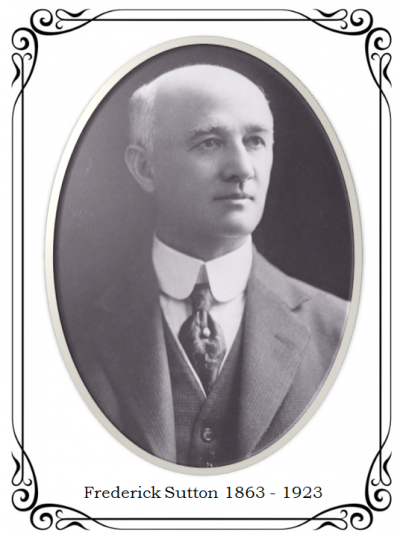
Later that month, Alfred Sutton’s younger son, Stanley Sutton, who had been managing the Bendigo store, was moved to Ballarat to take over his older brother Les’ managerial position and Les was recalled to Melbourne. By that time, A.Leslie Sutton was fully qualified in accountancy; in July 1923 he was elected honorary auditor of the Association of Public Accountancy Tutors. A fellow member at that time later became the Suttons Auditor, and a shareholder.
Almost a year after his brother Frederick’s death, Walter Sutton [below] died on 4 January 1924 aged 65.
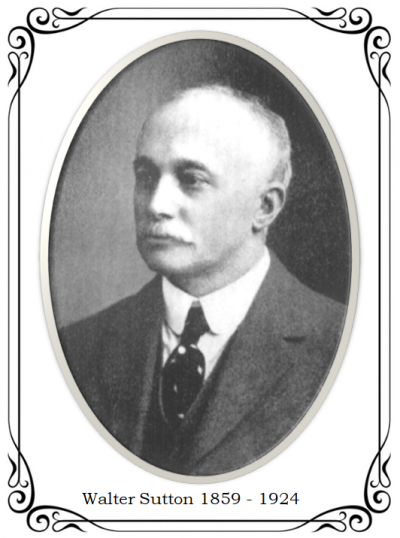
Alfred Sutton was now the sole remaining member of the 2nd generation of the Sutton family. With this loss of another member of the company directorate, major changes were needed in Suttons’ management.
It was time for the 3rd generation of Sutton menfolk
to come to the forefront in the company…
Stanley Sutton was recalled from Ballarat to the city branch, after just 6 months there.
On 24th March 1924 Alfred’s 2 sons: Alfred Leslie (Les) & Stanley Sutton; Walter’s son: Frederick George (George) Sutton and Frederick’s son: Francis Henry (Harry) Sutton were all appointed to the Suttons Board of Directors. A month later, at an Extraordinary General Meeting of the Suttons board members, the company’s Articles of Association were altered regarding Directors to allow ”a minimum of 3, and a maximum of 7” and that any new Director other than the 4 original Sutton brothers “shall have a minimum of 500 shares in his own right”. Five months later, an employee of Suttons viz. Alex Law Snr was also appointed as a director; he was the first who was not a Sutton family member. His appointment brought the total number of Directors to 6.
The advent of radio as a source of entertainment in the home had arrived on the Australian music scene during the early 1920s, and Suttons embraced this new technology with enthusiasm. The first broadcast of music in Australia was made during a demonstration on 13 August 1919. As with most countries, most Australian radio stations originally broadcast music interspersed with such things as talks, coverage of sporting events, church broadcasts, weather, news and time signals of various types. Virtually all stations also had programs of interest to women, and children’s sessions. On 1st December 1925 the inaugural wireless concert by Melbourne’s 3AR station was transmitted from Sutton’s Music Warehouse and was highly successful, judging by the many enthusiastic telephone messages received from listeners around the city’s suburbs and country areas.
Below : TROVE Sydney Morning Herald 4 December 1925
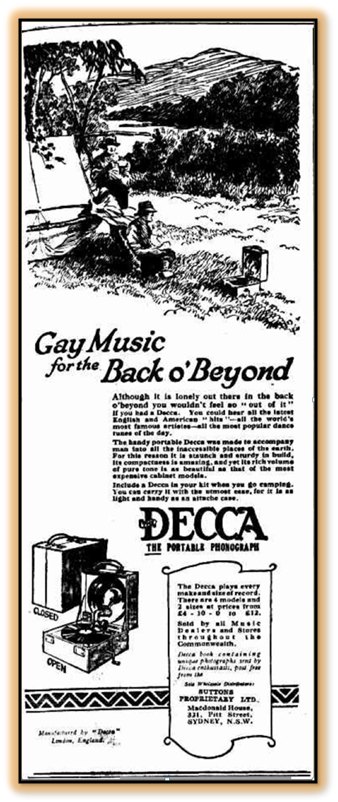
In the early 1920s Suttons acquired the valuable sole agency for the English DECCA company’s goods in Australia. When the first Suttons NSW advertisement which mentions this fact appeared in Sydney newspapers, their address is given as Macdonald House, 321 Pitt Street, Sydney.
Suttons had opened a Sydney store as a wholesale outlet in 1922, but this arrangement had proved somewhat unsatisfactory. In February 1925 George Sutton, not long returned from his war service, was sent overseas to USA and Europe to study new business methods, returning in August 1925. The decision was taken to open a retail store in NSW and George Sutton was sent to oversee it’s establishment. By the following year, the new Suttons DECCA agency in NSW was located at 309 Pitt Street, Sydney. This location was previously occupied by a music seller, to whom Suttons had also paid ₤1,000 for goodwill and purchased their stock. The premises were much altered and several thousand pounds were spent in making improvements. Business there was initially slow, but the company was optimistic of improvement, at first.
In 1927, ex-bank manager JAMES MARSHALL SAYER, who was also the son-in-law of Walter Sutton, was appointed as Company Secretary of Suttons in Melbourne.
On 11th July 1927 Alfred Sutton turned 70, and the company celebrated by presenting him with an expensive birthday gift. [It was for this occasion that Alfred Sutton wrote his memoir notes re the history of the Suttons music business, upon which this website’s information is partly drawn.]
A month later significant changes were again made to the Suttons’ Constitution.
Newspaper articles at the time of this change mention Suttons had “a branch in Adelaide” – Suttons never had a retail store in South Australia but for a while they did have an agency of their Suttons’ Concord piano company which was located in Adelaide. Suttons also had agencies at various times in several other large country towns eg Horsham, Victoria, Wollongong, NSW and even in New Zealand.
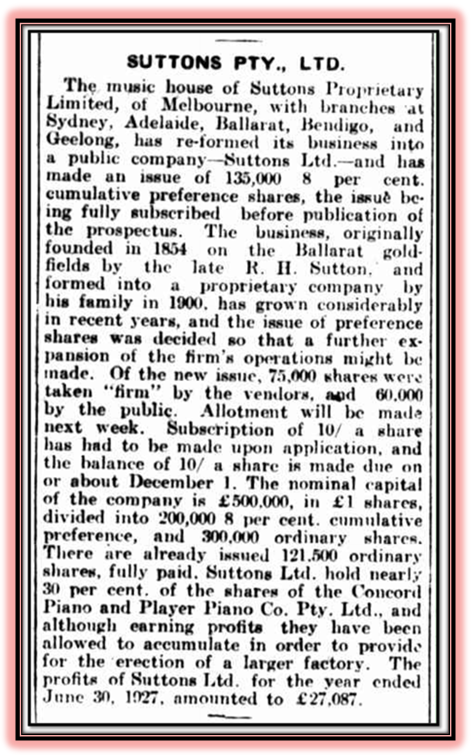
In 1927 Suttons turned a significant profit; in July 1926 it’s assets were valued at ₤471,400 and generally the business outlook appeared buoyant.
Below : TROVE Brisbane Courier 26 November 1927
In May 1928 Suttons purchased new NSW premises at 390 George Street, Sydney for £60,000 – a record price for the time, which soon proved to be exorbitant. This site had been occupied by the music warehouse business of Nicholson’s Ltd, with whom Suttons were already affiliated via the Concord company.
Early 1929 Suttons sold their Pall Mall shop and warehouse premises in Bendigo for ₤10,000 and opened in a new location at the corner of Mitchell and Queen Streets.
Meanwhile, back in NSW, after 9 months of extensive, expensive renovations the new Sydney premises in George Street opened on 1st March 1929.
Almost immediately after, the effects of the Great Depression
began to be felt in Australia…
Suttons’ profit fell away, although in July 1929 money was found to pay – from their reserves – an 8% dividend to holders of its preference shares that year .
The Wall Street crash of October 1929 led to a world-wide economic depression, and the Australian economy again collapsed.
In November 1929 – just 9 months after the Sydney store was opened – the decision was taken by the Suttons board to voluntarily wind the Sydney branch up, and liquidators were appointed. In late 1929 George Sutton, in some disgrace, was relieved of his duties in the Sutton family business. He resigned from the Suttons Board of Directors on 1/12/1929 and found employment in publishing & broadcasting. A trusted employee from Suttons head office in Melbourne, Stanley Stubley, was despatched to Sydney to oversee the closure of the struggling branch.