Centenary Celebrations and New Technology
In April 1950, E.Gordon Jones was appointed Managing Director of Suttons and remained the Chairman of the Directorate.
His son, Douglas M.Jones returned to Melbourne from Sydney and took a position in Suttons Co-ordinating & Finance department.
In March 1951 E.Gordon Jones and his wife, Violet nee Sutton undertook an overseas business trip, seeking fresh sources of instrumental stock. They visited England, Europe and the USA.
In March 1952 the Australian government imposed severe import restrictions, mainly on British goods, in an effort to stabilise Australia’s financial situation. The Prime Minister, Robert Menzies said in an address to the nation:
“Australia had to balance her imports and exports during the next 12 months,
or become internationally bankrupt.”
The bulk of these import restrictions remained in place for the next three decades.
With Stanley Sutton’s continuing illness, his son Jeffrey, still based in Newcastle, had had to assume control of his father’s considerable shareholding in Suttons, and Jeff thus qualified to be part of the directorate. He was formally appointed in June 1952.
During early 1954 a “price-cutting war” developed among the electrical-radio retailers of the coalfields area of Newcastle NSW, and it was Jeff Sutton, described in a news report at the time as a “courageous young man, an ex-army engineer officer” – who “stemmed the revolution and restored sanity to what was fast becoming a complete collapse of sane trading”. During the mid 1950’s In Newcastle, Jeff Sutton was very enthusiastic about introducing electronics into the music trade – he found that the electronic organ, keyboards and tape recorders were proving immensely popular.
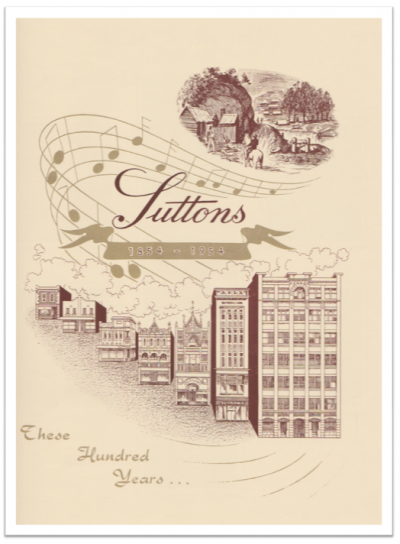
1954 saw the Centennial Year for Suttons arrive, and the company set about celebrating its 100 years in the Australian music business with considerable fanfare, tempered by its usual genteel dignity and refinement.